Strategic advisory in digital project delivery
It's your program.
And you can feel you're not being told everything.
An independent advisor, answerable to you alone. A free voice, where everything else is filtered.
On your program, right now
They report green. You sense red.
Dig beneath the green? No time, no latitude.
Everyone agrees. You're not fooled.
Naming the unspoken, from your chair: too risky.
No one dares tell you it's heading for the wall.
Everyone has something to protect. No one will say it.
All of it bears your name. And you know it.
You can't see it all, or carry it all, alone.
No one says it out loud. You carry it — nights included.
A project never sinks all at once. It drifts, in silence — and the longer you wait, the harder it is to right.
The root
It's not that no one sees.
It's that no one is free to say it.
Everyone is protecting something. And it's rarely your delivery.
None of them is dishonest. But the inconvenient truth has, with them, nowhere to go.
The truth was there, in every meeting. No one was free to tell you.
The free voice
I answer to you alone.
Paid from your budget, outside the project chain. So, free.
I'm not the integrator. I have no PMO above me. I'm not chasing the next contract. I have nothing to protect — except your delivery.
I see what others keep quiet. I name it. And I remove, one by one, what stands between you and delivery.
You're not buying one more report. You're buying a look into your blind spots.
True listening
At this level, you stand alone.
Everyone wants something from you. You can lean on no one.
Your doubts, your fears about this program, you carry in silence — confiding in anyone within the chain would be too risky.
I owe you the straight truth about your program. I also offer you true listening for what you're going through.
Why this role exists
Twenty years in the field.
Always the same wall.
I could see what would fail. My position forbade me from saying it.
I led large programs. Each time, the same wall: I saw the drift before the others, but I too had a superior, a contract, a place to hold. My voice was bound.
In twenty years, I never once met the role that would have changed everything: someone who knows the field, yet is entangled in nothing. I took it.
I am the fuse: I say what must be said, and I take the risk — in my place, not theirs.
Not one more method. The voice that was missing.
A case
“Your project isn't red.
It's dead.”
I told the sponsor at our very first meeting. He hired me for it.
A large real-estate program, at a financial institution. Over five million spent, several project managers gone, burned out. I tell him what no one dared: keeping it alive is therapeutic relentlessness.
Five million lost before a single person dared tell the truth.
Accept the losses, change the solution, give the business back its leadership. The dead program became one that delivers — first go-live on time, and deliveries ever since.
The engagement
Three levels. You choose the depth.
It begins with a conversation. You open the door as far as you wish — and no further.
Listening — a safe ear, beside the project
You talk to me, freely, in confidence. I give you the perspective no one around you can. No access to the project — just a clear mind facing yours.
The diagnostic — I step in, I see, I tell the truth · 2 to 3 weeks, fixed fee
You let me in. I see the real state of the program, I hear what others keep quiet, and I give you a clear verdict: continue, redirect, or stop.
The accompaniment — the free voice, over time
I stay at your side through the project. I keep the truth at the center, I name the unspoken, and I remove the obstacles — one by one, until it delivers.
Paid from your budget, never from the project's. With no loyalty other than yours.
The latest video
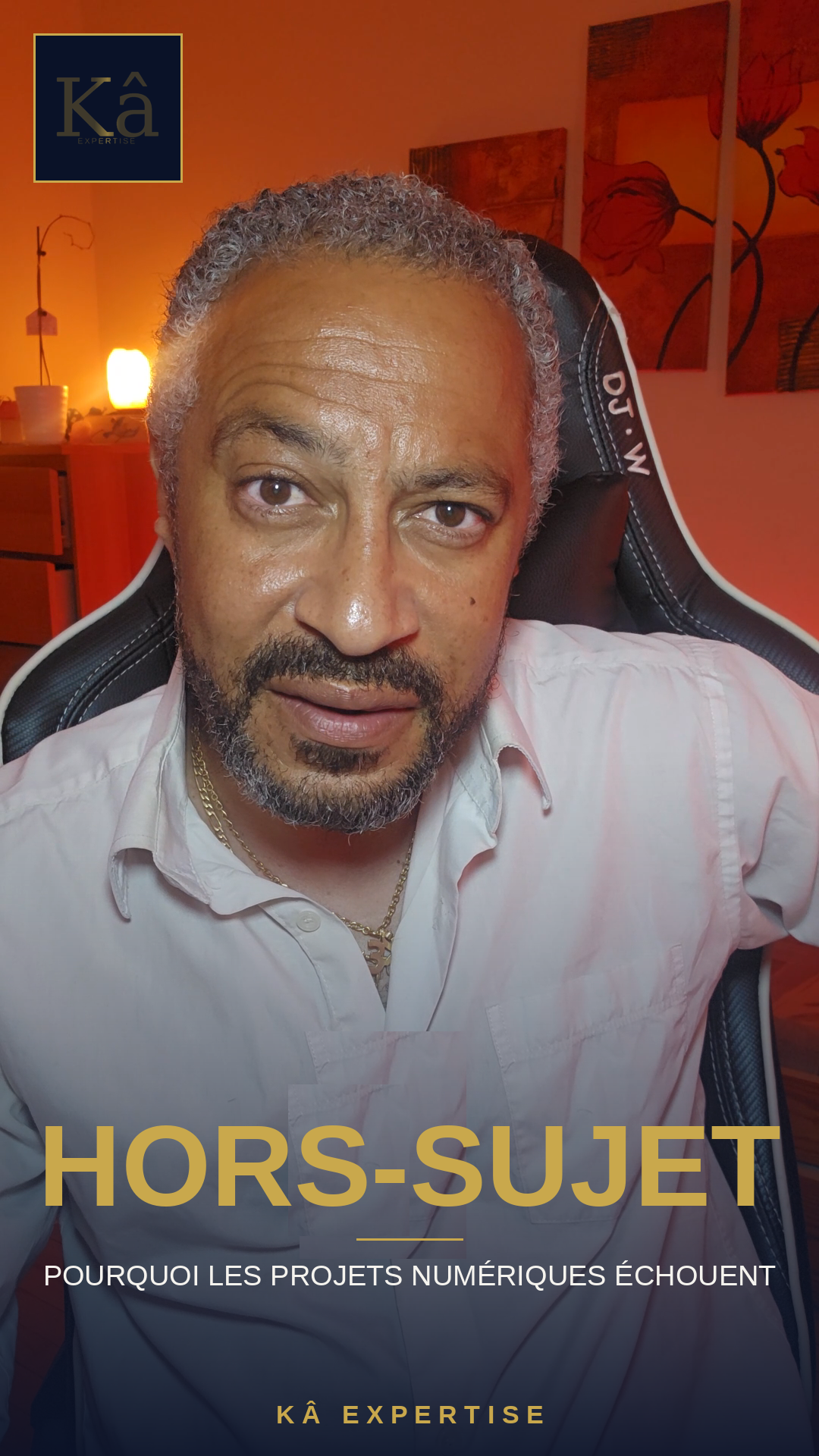
Off-Topic
Series “Why projects fail” — Ep. 4
Eighty slides on a project of extreme complexity. The only question asked at the kick-off had nothing to do with the project.
Watch →If you recognized yourself here, it all begins with a conversation — confidential, no obligation. And if I can do nothing for you, I'll tell you.
Let's talkor in writing: info@kaexpertise.com